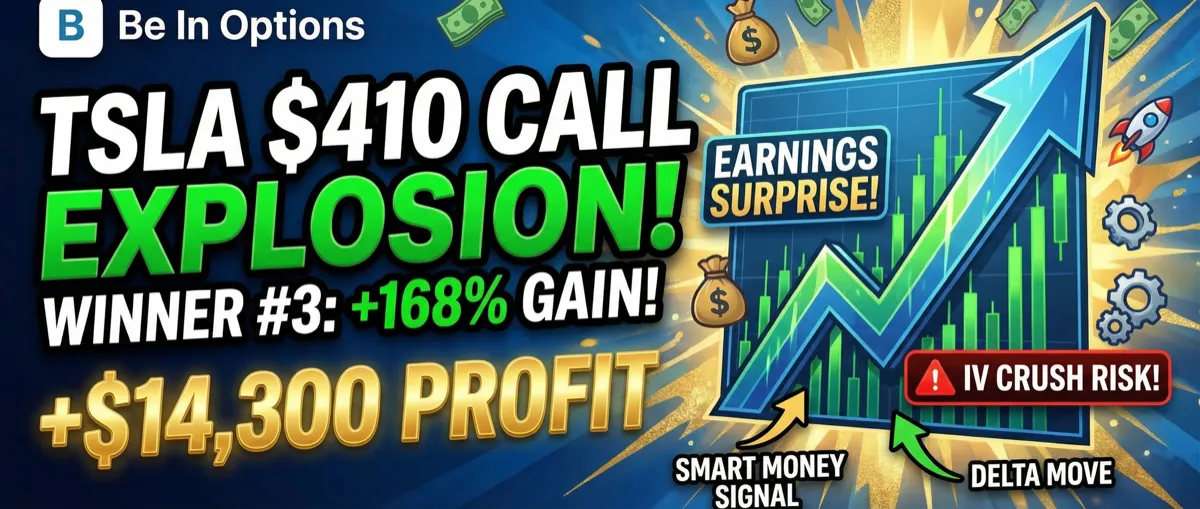
January 29, 2026 — Tesla reports Q4 results. Full-year 2025 brought the first revenue decline in company history: $94.8B vs. $97.7B in 2024. The market expected the worst. But Q4 surprised: EPS $0.50 vs. $0.45 expected, revenue $24.9B vs. $24.79B. The positive surprise pushed TSLA ~2% in after-hours trading — and accelerated the next day.
A TSLA $410 Call expiring February 7 rose from $8.50 to $22.80 — a profit of +$14,300 on 10 contracts. But this trade could just as easily have gone wrong.
Important Notice
Market data in this article is real. Trade scenarios are hypothetical examples for educational purposes. Earnings trades are especially risky due to IV crush risk.
The Catalyst
Tesla reported Q4 2025 results on January 29. Full-year 2025 was historic: for the first time, annual revenue declined — $94.8B versus $97.7B in 2024. The narrative was bearish. But the Q4 numbers told a different story:
Context note: Earnings surprises have the strongest impact when the market is extremely positioned in one direction. The full-year decline had pushed bearish sentiment to an extreme — the ideal setup for a squeeze.
Technical Analysis
- Pattern:Pre-earnings consolidation between $395 and $415 in the week before the report. Tight channel = compressed energy. The breakout came at market open on January 29 after the upside gap.
- IV Rank:78% — historically elevated, typical before earnings. This meant significant IV crush risk: even with the correct direction, the position could lose from volatility decline. In this case, the stock move (+$25) was large enough to offset the IV crush.
- OI Signal:Open Interest on the $410 strike surged by 12,000 contracts in the 24 hours before the earnings report. This aggressive positioning on a single strike suggested institutional conviction — the strongest pre-earnings signal.
Earnings Trade Warning
Why This Trade Is the Exception — Not the Rule
Earnings trades are fundamentally 50/50 bets with asymmetric risk against you. This trade worked only because the stock move (+$25) was exceptionally large.
1. IV Crush Is Asymmetric
Before earnings, IV rises 30-80%. After the release, it collapses immediately. This means: you pay a premium when buying that vanishes after the event — regardless of whether you were right. You need to get both direction AND magnitude right.
2. Correct Direction, Still a Loss
If TSLA had risen only +1% instead of the actual move, IV crush would have completely consumed the profit. Many traders experience exactly this: they get the direction right, but the move isn't large enough to offset the volatility decline.
3. Pros Use Spreads
Experienced traders don't buy naked calls or puts before earnings. They use vertical spreads (e.g., bull call spread) to neutralize the IV crush effect: the sold option has the same IV crush as the bought one. This reduces potential profit but eliminates the biggest risk.
Rule of thumb: If you can't quantify the IV crush effect, you shouldn't be making earnings trades.
Key Takeaway
Unusual Open Interest activity is the best pre-earnings signal. When smart money aggressively positioned 12,000 contracts on a single strike in 24 hours, it signaled institutional conviction about the direction of the earnings outcome.
But don't forget: even with the best signal, IV crush remains the asymmetric risk. OI analysis gives you an edge on direction — spreads give you an edge on risk.
Analyze Your Earnings Trades Like a Pro — For Free
Calculate the IV crush effect before you enter. Visualize payoff scenarios. No subscription. No hidden costs.
More Case Studies from February 2026
Frequently Asked Questions
Glossary: Key Terms
Disclaimer
The information on this page is for educational purposes only and does not constitute investment advice. Options trading involves significant risks and is not suitable for all investors. Earnings trades are especially risky due to elevated Implied Volatility and the IV crush effect.
*Names and amounts modified for privacy. Examples are hypothetical. Past performance is not indicative of future results.*

Author
Daniel Berg
Editor-in-Chief
Options Educator
Daniel Berg is an ordinary guy from a mid-sized German city. He spent over twenty years in sales at a mid-cap machinery company – finance was never his profession, it was his expensive lesson. In 2000 he put his first savings into Deutsche Telekom's "people's share", buying near €100 and watching it fall to €8. He burned more money on the Neuer Markt afterwards. Only in his mid-thirties did he start the boring, patient way – broad ETFs, patience, no hot tips. At BeInOptions, Daniel passes on exactly that lesson: no miracle returns, just plain-spoken education about options, risk and long-term investing. "I don't sell dreams. I explain the tools – and the mistakes I made myself."