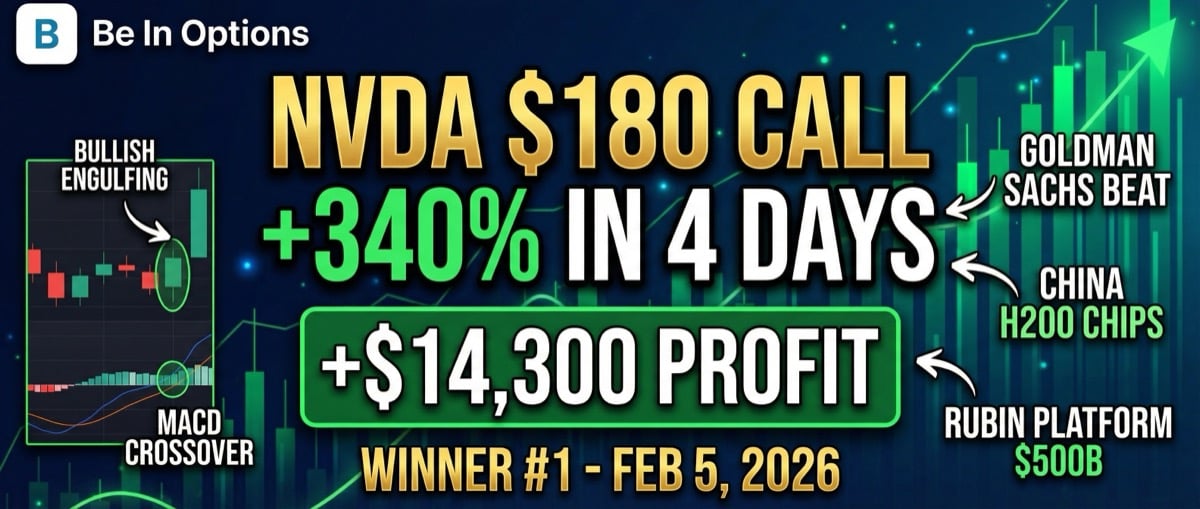
February 5, 2026 — exactly one year after the DeepSeek crash that wiped $589 billion from NVIDIA's market cap. The stock sat at $172, forming a pivot bottom signal. What followed was a trade that returned +340% in just 4 days.
Important Notice
Market data in this article is real. Trade scenarios are hypothetical examples for educational purposes. Options trading involves significant risk of loss.
The Catalyst
On February 5, 2026 — exactly one year after the DeepSeek crash — NVDA formed a pivot bottom signal at $172. The stock had been under pressure in prior weeks, but three catalytic events converged:
Technical Analysis
- Pattern:Bullish engulfing pattern on 4H timeframe at $172 support. Pivot buy signal confirmed on February 5.
- Levels:Price broke above 50 EMA at $178, then resistance at $185.40 with significant volume spike (+180% vs. 20-day average).
- Signal:MACD crossover in positive territory confirmed momentum. RSI rose from 38 to 67 without becoming overbought.
Key Takeaway
Anniversaries of major market events create predictable narratives. The DeepSeek crash of January 2025 created a "recovery anniversary" effect — analysts and media drove sentiment. The smart trader positioned at the pivot bottom, not at the top.
Analyze Your Trades Like a Pro — For Free
This NVDA trade could have been analyzed upfront with our free tools. No subscription. No hidden costs.
More Case Studies from February 2026
Frequently Asked Questions
Glossary: Key Terms
Disclaimer
The information on this page is for educational purposes only and does not constitute investment advice. Options trading involves significant risks and is not suitable for all investors.
*Names and amounts modified for privacy. Examples are hypothetical. Past performance is not indicative of future results.*

Author
Daniel Berg
Editor-in-Chief
Options Educator
Daniel Berg is an ordinary guy from a mid-sized German city. He spent over twenty years in sales at a mid-cap machinery company – finance was never his profession, it was his expensive lesson. In 2000 he put his first savings into Deutsche Telekom's "people's share", buying near €100 and watching it fall to €8. He burned more money on the Neuer Markt afterwards. Only in his mid-thirties did he start the boring, patient way – broad ETFs, patience, no hot tips. At BeInOptions, Daniel passes on exactly that lesson: no miracle returns, just plain-spoken education about options, risk and long-term investing. "I don't sell dreams. I explain the tools – and the mistakes I made myself."