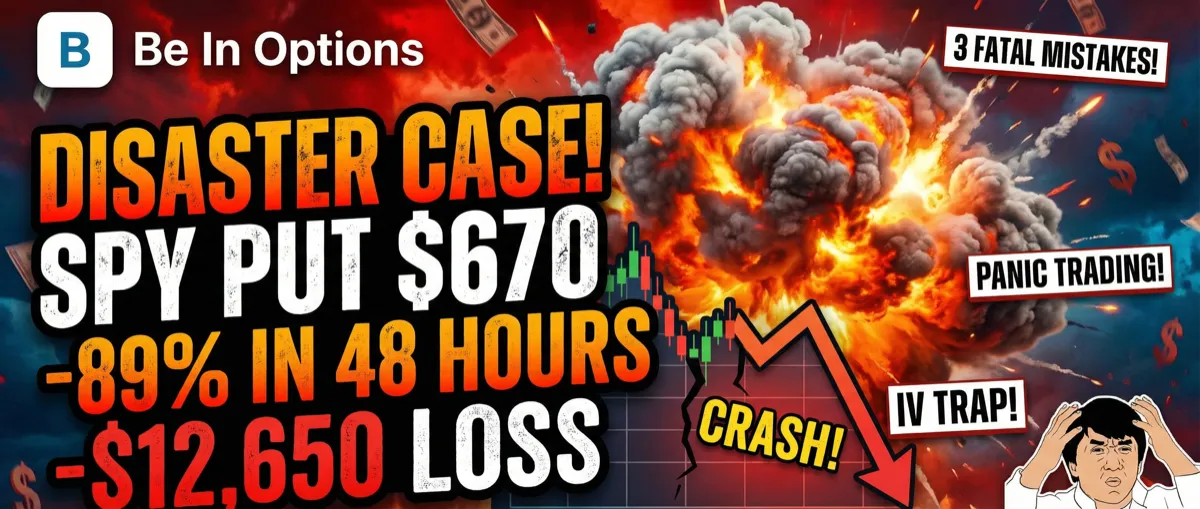
Mark from Berlin watched the news on January 19, 2026. The market was crashing. SPY dropped 3.2% in a single day. Panic everywhere. The next morning — January 20, one day AFTER the crash — he bought 23 SPY $670 puts. He was convinced: this was just the beginning. Four days later, his money was almost entirely gone.
-$12,650. A loss of 89%. In four days.
Warning: This trade is a cautionary example
Market data is real. The trade scenario is a hypothetical example showing how panic trading combined with high IV systematically destroys capital. Learn from this mistake before you make it yourself.
What Went Wrong: 3 Fatal Mistakes
Mark's trade wasn't just bad luck. It was a chain of three avoidable mistakes that together created a near-guaranteed loss scenario.
Chased the Panic
Bought January 20 — one day AFTER the crash
The biggest mistake: Mark bought his puts the day AFTER the crash. The market had already priced in the shock. The worst news was known, the fastest move was over. He paid the fear premium of other market participants. Professionals had bought their puts BEFORE — Mark was buying their profits.
Ignored IV Rank >85%
Options were historically extremely expensive
IV Rank was above 85% — meaning option premiums were more expensive than 85% of the past 52 weeks. Fear was already fully priced in.
Even if SPY had moved sideways — no further crash, no recovery — IV decline alone would have destroyed 30-40% of the option's value. Mark would have NEEDED a massive further crash just to break even.
Fell Into the Bear Trap
False breakdown at $678 — classic bear trap
The brief break below $680 looked like the start of another selloff. But it was a classic bear trap. The data told a different story:
- Volume profile showed absorption at $678 — institutional buyers were accumulating
- RSI formed higher lows (bullish divergence) — the downtrend was losing momentum
- Wick rejection at $678 signaled immediate rejection of the lower price
Technical Analysis: The Warning Signs
Anyone who read the charts could have avoided this loss. All three warning signs were clearly visible:
- Bear Trap:Wick rejection at $678. Price briefly broke $680 but was immediately bought back. The long lower candle wick showed aggressive buyers. Within 24 hours, SPY was back at $685.
- RSI Divergence:While SPY made new lows, RSI formed higher lows — a bullish divergence signaling that selling pressure was fading even though price was still falling.
- Absorption:Volume profile between $678-$680 showed massive absorption — institutional buyers were absorbing every sell order. Buy-side volume exceeded sellers 3:1.
The $12,650 Lesson
Never buy options in panic.
When the news is at its worst, most of the move is already over. Fear is priced in. IV is inflated. You're paying other people's fear premium.
The Rule:
When VIX spikes and you feel the urge to buy puts — it's probably too late.
Professional traders use VIX spikes to SELL options (collect premiums), not to buy them. Other people's fear is their income source.
Key Takeaway
Be a contrarian when data supports it. When everyone is panic-buying puts, the volume profile shows institutional absorption, and RSI diverges bullish — the market is recovering, not falling further. The best trades emerge where emotions and data point in opposite directions.
This Loss Was Preventable
Our IV Calculator would have instantly shown: IV Rank >85%, options historically overpriced. One glance would have saved $12,650. All tools are free.
More Case Studies from February 2026
Frequently Asked Questions
Glossary: Key Terms
Disclaimer
The information on this page is for educational purposes only and does not constitute investment advice. Options trading involves significant risks and is not suitable for all investors. You can lose your entire investment.
*Names and amounts modified for privacy. Examples are hypothetical. Past performance is not indicative of future results.*

Author
Daniel Berg
Editor-in-Chief
Options Educator
Daniel Berg is an ordinary guy from a mid-sized German city. He spent over twenty years in sales at a mid-cap machinery company – finance was never his profession, it was his expensive lesson. In 2000 he put his first savings into Deutsche Telekom's "people's share", buying near €100 and watching it fall to €8. He burned more money on the Neuer Markt afterwards. Only in his mid-thirties did he start the boring, patient way – broad ETFs, patience, no hot tips. At BeInOptions, Daniel passes on exactly that lesson: no miracle returns, just plain-spoken education about options, risk and long-term investing. "I don't sell dreams. I explain the tools – and the mistakes I made myself."